Pakistan's Export Odyssey: Bridging the $64 Billion Gap to a $100 Billion Dream
The Unseen Lifeline of Global Trade-imagine a global economy where transactions worth trillions unfold daily, powered by an often-overlooked engine-Trade Finance. In 2024 alone, $9.7 trillion in global trade relied on these vital instruments. Yet, this critical system is under immense strain.
Muhammad Aneel Iqbal · December 11, 2025Global trade remains the lifeblood of the world economy and more than 80% of trade volume relied on trade finance instruments, underscoring its indispensable role in powering commerce and supply chains yet the system faces a growing strain. ADB’s 2023 Trade Finance Gaps, Growth & Jobs Survey shows the global trade finance gap has ballooned to US$2.5 trillion, up from US$1.7 trillion just two years earlier and for SMEs, the true engines of inclusive growth, the struggle is real. SMEs trade finance applications faced a daunting 45% rejection rate in 2023 resulting in an unmet trade finance demand of staggering $120 billion in Africa and $700 billion in developing Asia. This unmet demand is not just a statistic; it's a colossal missed opportunity, especially in developing economies.
According to the Economic Cooporation Organization (ECO), Pakistan’s total Exports (FY2023) were approximately for $35.9 billion, positioning Pakistan as the 66th largest exporter globally but Pakistan's exports represent roughly 0.14% of global trade. Pakistan's economic heartbeat heavily relies on its SMEs, which contribute ~40% to GDP. A nation brimming with potential yet these vibrant businesses remain structurally locked out of formal trade finance. This exclusion is not just an inconvenience; it’s a chokehold on export growth. This challenge presents both a formidable hurdle and an unprecedented opportunity.
Pakistan's SME finance landscape is shallow, narrow, and costly lagging behind its Asian counterparts. Pakistan's SME bank loans constitute only 6% of total bank loans, starkly contrasting with India's 18% and Sri Lanka's 10%. In terms of GDP penetration, Pakistan's 0.5% in comparison to India's 7.9%. The SME equity market offers a similar stark picture-3 in Pakistan versus 835 in India and 18 in Bangladesh.
Vision 2035: Uraan Pakistan – A Flight Path to $100 Billion
Pakistan is not standing idly by. The "Uraan Pakistan" vision, coupled with the "5Es framework," sets an ambitious target of $60 billion in annual exports by 2029 and an astounding $100 billion by 2035. To achieve this target by 2035, Pakistan needs to sustain an annual growth rate of approximately 11%- significantly higher than the current 6.4%. This gap represents a $64 billion challenge between the current $35.9 billion and the 2035 target, whereas 10-year Average Growth stood at 2.2% significantly short of the required 11% CAGR.
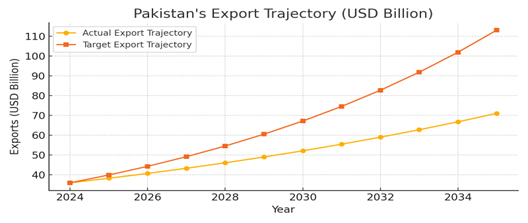
The journey ahead is challenging, demanding collective effort and unwavering commitment. But the prize- a prosperous, inclusive, and globally integrated Pakistan is well worth the flight. This is not mere incremental tinkering; it's a strategic re-architecture of Pakistan's trade finance ecosystem, aimed at fostering inclusivity, resilience, and global competitiveness.
By-Muhammad Aneel Iqbal